Eldris data · The Sellers Index
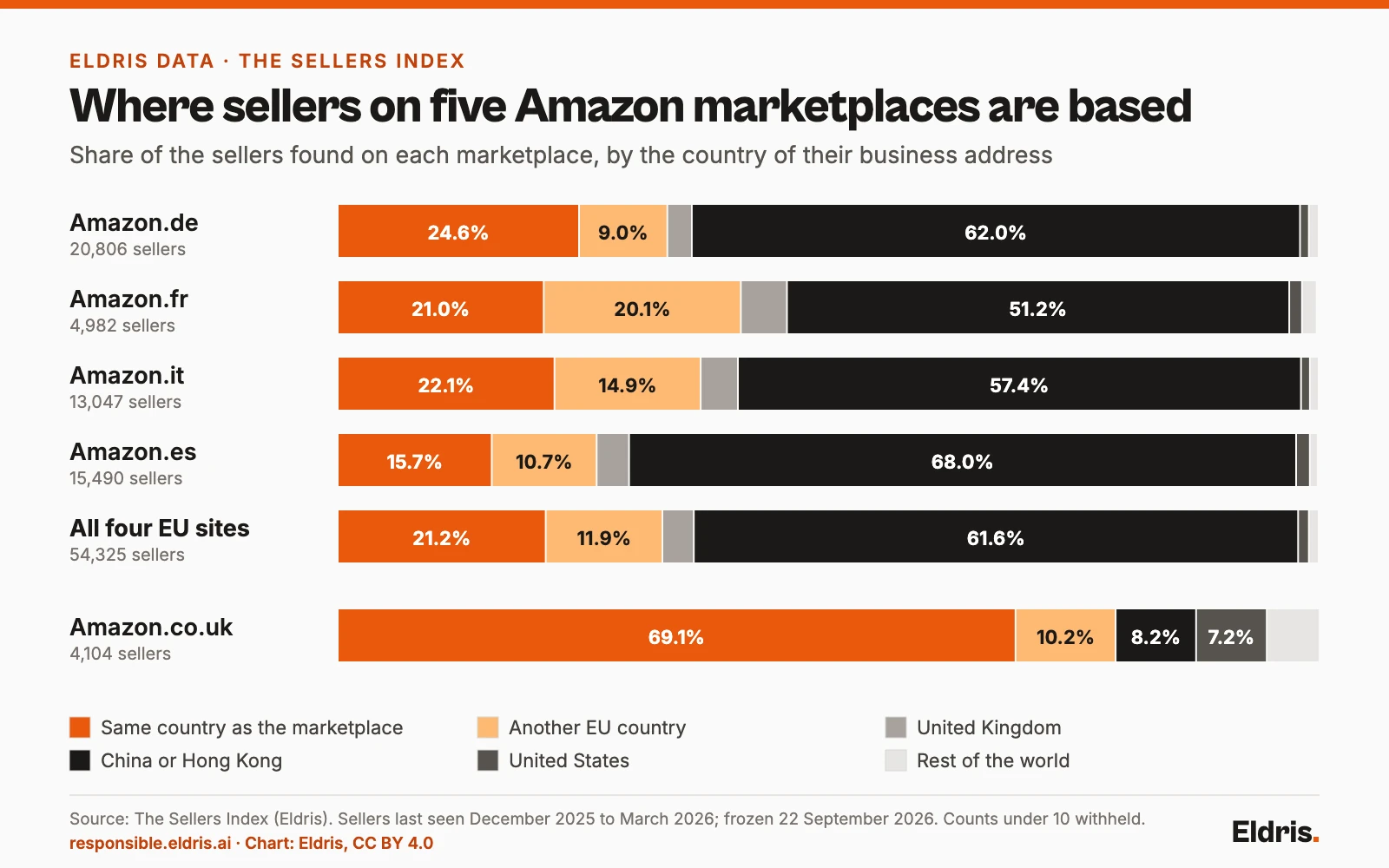
Where sellers on Amazon Germany, France, Italy, Spain and the UK are based, 2026
Published · Last updated · Data: The Sellers Index, frozen · Tables and chart: CC BY 4.0
Of the 54,325 sellers with a recorded country that The Sellers Index found on Amazon.de, Amazon.fr, Amazon.it and Amazon.es, 66.9% had a business address outside the EU and 61.6% were based in China or Hong Kong; 21.2% were based in the country of the marketplace they were found on (last seen December 2025 to March 2026). On Amazon.co.uk, 30.9% of 4,104 sellers were based outside the UK.
The figures say where sellers are based. They say nothing about whether any seller complies. What the location means for the Responsible Person rules: EU authorised representative for non-EU sellers. Eldris is an EU & UK Responsible Person at £195 per market, one-off, then from £19.95 a month: appoint online.
Email me my price
Your Responsible Person price, by email
Choose your markets and what you sell. The price updates as you choose, and we email it to you as a PDF quotation.
66.9%
of the 54,325 sellers found on Amazon DE, FR, IT and ES are based outside the EU
61.6%
of those sellers are based in China or Hong Kong
21.2%
of those sellers are based in the marketplace's own country
30.9%
of the 4,104 sellers found on Amazon.co.uk are based outside the UK
By marketplace
Share of the sellers found on each EU marketplace, by where their business address is.
| Marketplace | Sellers | Same country | Other EU | UK | China or Hong Kong | US | Elsewhere | Outside the EU |
|---|---|---|---|---|---|---|---|---|
| Amazon.de | 20,806 | 24.6% | 9.0% | 2.5% | 62.0% | 0.9% | 1.0% | 66.4% |
| Amazon.fr | 4,982 | 21.0% | 20.1% | 4.7% | 51.2% | 1.3% | 1.5% | 58.8% |
| Amazon.it | 13,047 | 22.1% | 14.9% | 3.8% | 57.4% | 0.9% | 0.9% | 63.0% |
| Amazon.es | 15,490 | 15.7% | 10.7% | 3.3% | 68.0% | 1.4% | 0.8% | 73.6% |
| All four | 54,325 | 21.2% | 11.9% | 3.2% | 61.6% | 1.1% | 1.0% | 66.9% |
On the four marketplaces together, 78.8% of sellers are based outside the country of the marketplace they were found on. Outside the EU, the largest groups are China (59.6%), the United Kingdom (3.2%), Hong Kong (2.0%) and the United States (1.1%).
| Country | Sellers | Share of all sellers found |
|---|---|---|
| China | 32,387 | 59.6% |
| United Kingdom | 1,759 | 3.2% |
| Hong Kong | 1,087 | 2.0% |
| United States | 603 | 1.1% |
| Switzerland | 100 | 0.2% |
| India | 95 | 0.2% |
| Taiwan | 53 | 0.1% |
| Türkiye | 46 | 0.1% |
Amazon.co.uk
| Marketplace | Sellers | UK | EU | China or Hong Kong | US | Elsewhere | Outside the UK |
|---|---|---|---|---|---|---|---|
| Amazon.co.uk | 4,104 | 69.1% | 10.2% | 8.2% | 7.2% | 5.4% | 30.9% |
20.7% of the sellers found on Amazon.co.uk are based outside both the UK and the EU.
By product category
The category is the Amazon category The Sellers Index files each seller under, grouped. Beauty is the Amazon category where cosmetics are listed; electronics and computers, and toys and games, are product groups with their own EU rules.
| Category | Sellers | Same country | China or Hong Kong | Outside the EU |
|---|---|---|---|---|
| Beauty | 5,630 | 22.4% | 58.5% | 64.6% |
| Electronics and computers | 9,625 | 17.0% | 64.1% | 69.9% |
| Toys and games | 4,897 | 17.2% | 68.6% | 73.5% |
| All other categories | 34,173 | 22.7% | 60.4% | 65.5% |
| Category | Sellers | UK | Outside the UK |
|---|---|---|---|
| Beauty | 808 | 55.6% | 44.4% |
| Electronics and computers | 1,281 | 69.7% | 30.3% |
| Toys and games | 144 | 65.3% | 34.7% |
| All other categories | 1,871 | 74.7% | 25.3% |
What the Responsible Person rules say about where a seller is based
The rule attaches to the product. A product covered by the General Product Safety Regulation may not be placed on the EU market unless a business established in the EU is responsible for it. Where the seller is based decides who can hold that role: a manufacturer or importer established in the EU holds it itself, and a seller outside the EU needs its EU importer or an authorised representative with a written mandate. Only where none of those exists does a fulfilment service provider hold it, for the products it handles. The acts listed in Regulation (EU) 2019/1020 Article 4(5), among them the toy, electrical and radio equipment rules in its original text, carry the same requirement under that Regulation.
In beauty, the Amazon category where cosmetics are listed, 64.6% of 5,630 sellers on the four EU marketplaces are based outside the EU, and 44.4% of 808 on Amazon.co.uk are based outside the UK. A cosmetic may be placed on the EU market only if a person within the EU is designated as its Responsible Person, and in Great Britain only if there is a responsible person established in the United Kingdom.
Who must appoint an EU authorised representative, what it costs and how long it takes
Eldris's own data: how soon the certificate file is created
The certificate is generated automatically once the payment is recorded, so in practice it arrives within minutes; the checkout states: certificate within 60 minutes of completing onboarding.
The measurement starts when the payment is recorded: it does not include the time spent on the onboarding form, or when the email is opened. It covers every active, non-test appointment on the day it was measured: a small sample, and a record of what has happened rather than a commitment.
How the figures were made
- Source. The Sellers Index, Eldris's own record of Amazon third-party sellers. The table held 82,450 records, not all of them Amazon sellers. These tables are the 58,429 Amazon sellers that carry one of five marketplaces and a recorded country, last seen between 4 December 2025 and 18 March 2026. Eldris counted them on 22 September 2026; the same figures were first published on consult.eldris.ai.
- Marketplace. The Amazon marketplace on which The Sellers Index found the seller (one per seller). Sellers found on other marketplaces, or with none recorded, are not in these tables.
- Based in. The country of the business address recorded for the seller. Sellers with no recorded country are left out (241 across the five marketplaces).
- Categories. Beauty, electronics and computers, and toys and games are grouped from Amazon's category names, including their German, French, Italian and Spanish versions. Everything else is "All other categories".
- Privacy. Only totals are published. Counts of sellers under 10 are withheld and shown as "fewer than 10". No seller is named or can be identified.
- Last-seen windows. The sellers on each marketplace were last seen in different windows: Amazon.de 4 December 2025 to 20 February 2026; Amazon.fr 31 January 2026 to 18 March 2026; Amazon.it 29 January 2026 to 18 March 2026; Amazon.es 12 February 2026 to 18 March 2026; Amazon.co.uk 4 December 2025 to 20 February 2026.
- Certificate time. Read-only query on Eldris's database on 26 September 2026: seconds from each active appointment's first recorded payment to the creation of its certificate file.
Limits
- This is the sample The Sellers Index collected, not a census of Amazon. Read the shares as "of the sellers found", not "of all sellers on Amazon".
- Differences between marketplaces may partly reflect the different last-seen windows.
- A seller can sell on several marketplaces; here each is counted once, on the marketplace where it was found.
- The sample matters. The Sellers Index's smaller enriched set of 16,931 sellers with contact details, which the 12 earlier data pages on this site quoted, puts 14.3% of its 9,578 seller-marketplace pairs on the four EU marketplaces outside the EU. Most of the difference is the website: in the full table, sellers with a website are 19.6% outside the EU (15,253 sellers) and sellers without one 85.4% (39,072), and the enriched set is mostly sellers with a website. Those earlier pages now lead here.
- Where a seller is based says nothing about whether it complies. This page makes no claim that any seller does or does not.
Licensed CC BY 4.0: credit "Eldris (responsible.eldris.ai)" and "The Sellers Index". Download the figures as CSV.
Questions
What share of Amazon sellers in the EU are based outside the EU?
In The Sellers Index data, 66.9% of the 54,325 sellers with a recorded country found on Amazon.de, Amazon.fr, Amazon.it and Amazon.es (last seen December 2025 to March 2026) had a business address outside the EU, and 61.6% were in China or Hong Kong. Only 21.2% were based in the country of the marketplace they were found on.
What share of Amazon.de sellers are based in Germany?
24.6% of the 20,806 sellers with a recorded country found on Amazon.de had a German business address. 62.0% were based in China or Hong Kong and 66.4% outside the EU.
What share of Amazon UK sellers are based outside the UK?
30.9% of the 4,104 sellers with a recorded country found on Amazon.co.uk had a business address outside the UK, and 20.7% were based outside both the UK and the EU.
Where does this data come from?
From The Sellers Index, Eldris's own record of Amazon third-party sellers. Eldris counted the sellers it held by the marketplace each was found on and the country of its recorded business address, and froze the counts on 22 September 2026. Only totals are published; no seller is named.
Why did earlier Eldris pages give different numbers?
The pages published in June 2026 used The Sellers Index's smaller enriched set of 16,931 sellers with contact details. In that set 14.3% of the seller-marketplace pairs on the four EU marketplaces are based outside the EU. Most of the difference is the website: in the full table, sellers with a website are 19.6% outside the EU and sellers without one 85.4%, and the enriched set is mostly sellers with a website. Those pages now lead here.
Sources
- The Sellers Index: Eldris's own record of Amazon third-party sellers; first published on consult.eldris.ai, with the figures as CSV
- Regulation (EU) 2023/988 on general product safety (GPSR) (EUR-Lex)
- Regulation (EU) 2019/1020 on market surveillance and compliance of products (EUR-Lex)
- Regulation (EC) No 1223/2009 on cosmetic products (EUR-Lex)
- SI 2019/696, Schedule 34: cosmetic products in Great Britain (legislation.gov.uk)